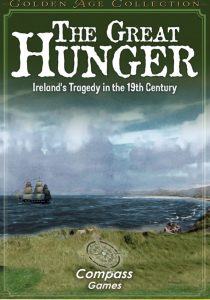
The Great Hunger board game by Compass Games has drawn sharp criticism from the Ancient Order of Hibernians, which argues that gamifying Ireland’s Great Hunger (An Gorta Mór) trivializes one of history’s gravest human catastrophes. Framing mass starvation, forced emigration, and generational trauma as a competitive exercise distorts historical reality and undermines any serious educational claim about the Great Hunger and its causes.:
The Ancient Order of Hibernians is both saddened and outraged by the announcement of The Great Hunger board game by Compass Games.
We are saddened because we believe there is a kernel of good intentions on the part of the game’s designer, Kevin McPartland, to educate through the medium of a game. However, we are disappointed that this project appears never to have asked the fundamental question of whether an event that resulted in the deaths of at least one million people by starvation, and the forced emigration of another million, should be gamified at all.
Mr. McPartland has stated, “I do not expect a single Irish person to buy this game,” and has instead presented it as a tool to educate his fellow Americans. Yet, judging by the game’s own promotional video, Mr. McPartland and Compass Games would benefit from further education themselves on the famine before presuming to instruct others.
The promotion for the game states:
“It’s the start of the 19th century, and you represent groups of tenant farmers and field hands thriving in Ireland and expanding across the country with a growing population fueled by this wonder crop, the potato. However, the potato blight will hit in 1845, causing massive famine and leading to the deaths of over a million people over the next decade. So you’ll have to immigrate your clan to America and scramble to survive in The Great Hunger, Ireland’s Tragedy in the 19th century.”
Compass Games Promotional video
It may come as a shock to Mr. McPartland and Compass Games, but tenant farmers and field hands were not ‘thriving’ in Ireland. Centuries of dispossession, land confiscation, and Penal Laws had forced the native Irish onto ever-smaller parcels of land—plots so marginal that the only crop capable of sustaining life was what the game describes as the “wonder crop” of the potato.
Ireland had already endured numerous subsistence crises and localized famines before 1845.These should have served as unmistakable warnings to a foreign government that claimed dominion over Ireland while denying responsibility for its people.
Only months before the arrival of potato blight, the British Parliament’s own DevonCommission reported that it was “impossible adequately to describe” the “privations” of Irish labourers; that in many districts “their only food is the potato” and “their only beverage water,” and that even a bed or blanket was “a rare luxury.” These words from Parliament’s own appointed committee are hardly a portrait of a people “thriving” on a “wonder crop.”
While the intent to educate Americans about the Great Hunger may be laudable, education must be accurate. Games can sometimes serve as a stimulus to learning, but one must seriously question the decision to gamify a human catastrophe in which the “prize” is survival.
Those who disembarked from coffin ships, having left their homeland and families behind, often forever, did not experience a sense of triumph or “winning.” Survival under such conditions was not a victory; it was trauma.
The ability to exist is the most basic of human rights, not a prize to be awarded. Some subjects, particularly those involving mass death through hunger and displacement, should not be reduced to a game.
AOH National Anti-Defamation Chair Neil F. Cosgrov