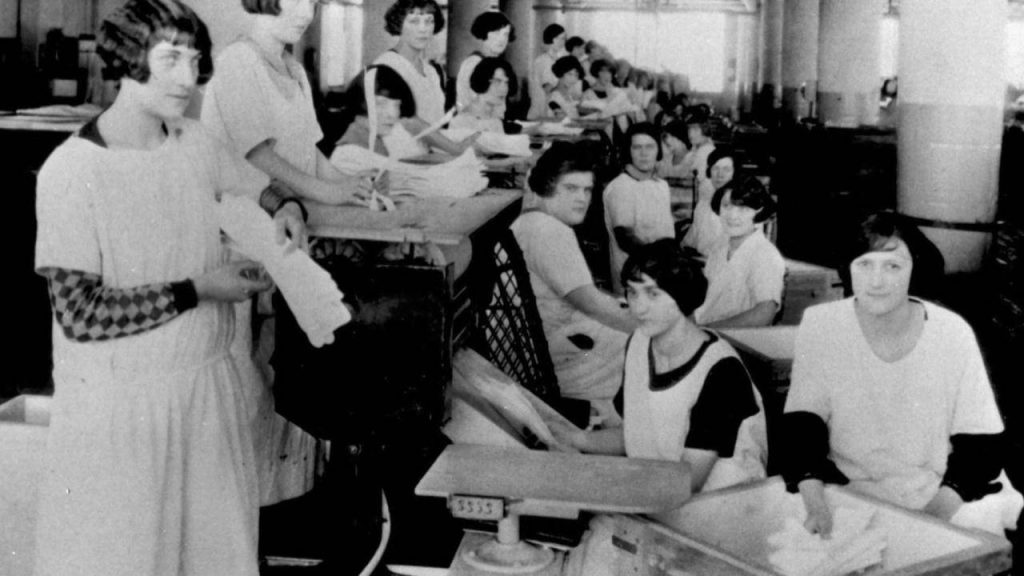
Kate Mullany was a nineteen-year-old Irish immigrant when she became the head of her household. Her father had died in 1864, leaving behind a sickly mother and three sisters, and a brother who depended on her to survive. Like many daughters of Irish immigrants in Troy, New York, she went to work in the one place that offered steady pay to women: the collar laundries.
Troy, New York, at the time, was known as Collar City. The detachable linen collar had become an essential fixture of respectable dress. Troy produced most of the nation’s collars, but before they reached the market, they had to be finished.
That finishing work fell largely to Irish American women. Some 3,000 women — nearly half of Troy’s female industrial workforce — were employed in the collar industry. Collars fresh from the factories arrived in laundries, where they were boiled, chemically bleached, starched, dried, and pressed into the stiff form customers expected. The work required skill, but it was punishing. Workers handled scalding water and harsh bleaching agents daily. They pressed linen with heavy irons heated by coal in rooms thick with steam. It was factories like these that gave rise to what became known as the “sweatshop.”
Burns were common; working with dangerous and potentially disfiguring chemicals was routine. Workdays stretched from twelve to fourteen hours for an average pay of three to four dollars a week. If a collar was damaged, the cost was deducted from the worker’s meager wages. If she was injured, she was left to her own devices without pay.
Kate entered this system out of necessity. What she saw was not just hardship, but injustice. In February 1864, she helped change that. Working with coworkers Esther Keegan and Sarah McQuillan, Mullany helped organize roughly 300 women across Troy’s laundries into what became the Collar Laundry Union.
Within days, they struck. Their demands were simple: better wages and relief from dangerous conditions. The strike began on February 23. Within a week, it succeeded.
Laundry owners conceded a wage increase of roughly 25%, a tremendous gain for these women whose families lived week to week.
The union did not vanish after its first success. It endured, organizing further actions and building a treasury that rivaled many male unions of the period, allowing it to offer sick benefits to its members and to support the formation of other women’s unions.
In 1868, Mullany’s leadership drew national attention. She was appointed Assistant Secretary of the National Labor Union — the first woman to hold a national office in an American labor organization. In that role, she worked to encourage organization among working women beyond Troy. On her appointment, President William Sylvis stated in his closing speech:
“We now have a recognized officer from the female side of the house – one of the smartest and most energetic women in America; and from the great work which she has already done, I think it not unlikely that we may in the future have delegates representing 300,000 working women.”
The Collar Laundry Union would ultimately fade by 1870, weakened by employer resistance and by technological change, notably the rise of disposable paper collars that undercut the linen trade.
For more than six years, the Collar Laundry Union endured — longer than any previous all-female labor organization in the United States.
Kate Mullany did not set out to become a labor leader. She set out to support her family. In doing so, she showed that Irish immigrant women were not merely workers in America’s industries — they could organize within them.
She should be remembered for helping pioneer the right of working women to shape their own working conditions. She is not widely remembered because history has too often overlooked Irish immigrant women whose leadership came from necessity, not status.
That needs to change.
That is why we need Irish American Heritage Month.