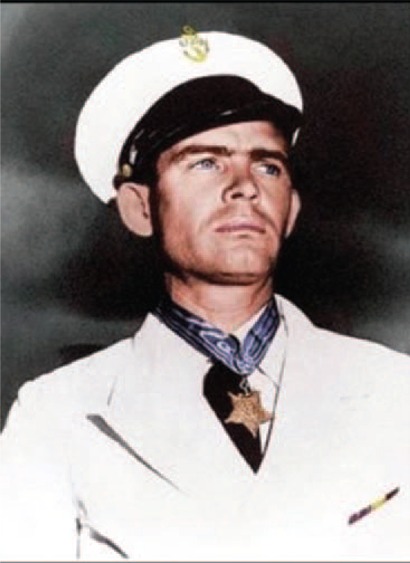
On the morning of December 7th, 1941, John William Finn was asleep at his home at Kaneohe Bay Naval Air Station on Oahu when a neighbor’s pounding on his door and the sound of gunfire jolted him awake. The Imperial Japanese Navy had launched a devastating sneak attack without warning or declaration of war, and Finn and 32-year-old Chief Petty Officer and chief aviation ordnance man was about to be among the first to fight back.
Born in Compton, California in 1909, Finn had dropped out of school and enlisted in the Navy at the age of 17. Now at 32, he had risen to the rank of Chief Petty Officer and was assigned as the chief aviation ordnance man in charge of a detail of twenty men at Kaneohe Bay Naval Air Station on Oahu.
On the morning of December 7th, Finn was at home with his wife when he was awakened by the sound of gunfire and a neighbor pounding on his door. Still not fully aware of what was happening, Finn jumped in his car and drove toward the airstrip observing the base speed limit — until a plane passing overhead revealed the Japanese “Rising Sun” insignia on its wing. “I threw it into second [gear],” Finn recalled, “and it was a wonder I didn’t run over every sailor in the air station.”
On reaching the hangars, Finn arrived at a scene of burning planes, scrambling men, and desperate confusion. He spotted his squadron’s painter carrying a .50 caliber machine gun salvaged from one of the damaged aircraft and commandeered it on the spot. “I knew I had more experience firing a machine gun than a painter.”
Finn mounted the gun on a movable training platform, pushed it into the open where he had a clear field of fire against the attacking Japanese planes — and where he was completely exposed to enemy fire in return. He did not hesitate. “I got the gun and I started shooting at Jap planes,” he said. “In some cases I could see their faces.”
For the next two hours Finn conducted his own personal war. He kept firing despite sustaining 21 distinct wounds — among them a bullet through his foot and a shrapnel wound to his shoulder that cost him the use of his left arm. He is credited with shooting down at least one enemy fighter and is believed to have damaged several more, though he would never claim it. “I can’t honestly say I hit any,” he said in a 2001 interview. “But I shot at every damn plane I could see.”
Finn did not leave his position until ordered to seek medical attention. At sick bay, surrounded by men far worse off than himself, he allowed the medics to bandage him — then checked himself out and returned to the armory, where he spent the rest of the day and night repairing damaged weapons in case of a further assault. Only a second, more explicit order sent him back to the hospital, where he spent the next two weeks recovering.
On September 14, 1942, Admiral Chester Nimitz presented Finn the Medal of Honor aboard the USS Enterprise. Finn accepted it with characteristic modesty. “I was just an uneducated man who got mad as hell one day.” When called a hero in a 2009 interview, he pushed back: “That damned hero stuff is a bunch of crap, I guess. You gotta understand that there’s all kinds of heroes, but they never got a chance to be in a hero’s position.”
Finn continued to serve in the U.S. Navy until 1956, attaining the rank of lieutenant. After the war he returned to California, where he, his wife, and their son ran a small ranch. He and his wife also became foster parents to five Native American children, an act of quiet generosity that earned them an honor from the Diegueno tribe. John William Finn was also a proud member of the Ancient Order of Hibernians.
He remained active on his ranch until shortly before his death on May 27, 2010, at the age of 100 — the last surviving recipient of the Medal of Honor for actions at Pearl Harbor. He is buried on the reservation of the children he helped raise.
His Medal of Honor citation concludes that Finn’s actions were “in keeping with the highest traditions of the U.S. Naval Service.” His life — in uniform and out of it — reflects something equally important: the highest traditions of Irish Americans and Hibernians. It is our duty to see that his memory, and the memory of Irish Americans like him, is never allowed to fade.