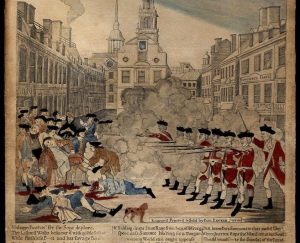
On the night of March 5, 1770, British soldiers fired into a crowd on Boston’s King Street.
The shooting left five men dead and helped ignite the chain of events that would lead to the American Revolution. Patriot leaders seized upon the event, pamphlets spread the story across the colonies, and Paul Revere’s famous engraving turned the episode into a symbol of British tyranny.
Most Americans know the name Crispus Attucks.
Far fewer remember Patrick Carr.
Carr was a thirty-one-year-old Irish Catholic immigrant and a skilled leather-breeches maker who had come to Boston seeking what so many immigrants sought: steady work and a chance at a stable life.
Yet the words he spoke while dying after the shooting would become one of the most consequential pieces of testimony in the famous Boston Massacre trial.
In one of history’s ironies, the same man whose dying words helped save the soldiers would see his Irish identity used against him in the courtroom.
Patrick Carr stood at the center of one of the seminal events in American history.
Yet history has largely forgotten him.
A Man of Steady Character
Patrick Carr worked as a leather-breeches maker on Queen Street in the shop of another Irishman, John Field. He was not a political agitator. He was a tradesman, a journeyman craftsman who had crossed the Atlantic seeking stability through honest work.
Boston on the evening of March 5 was already tense. British troops had been stationed in the city to enforce Parliament’s tax laws, and their presence was deeply resented. Matters were made worse by the fact that off-duty soldiers often competed with workingmen for employment.
The spark came when a young apprentice named Edward Garrick publicly accused a British officer, Captain John Goldfinch, of failing to pay a barber’s bill. The bill had already been settled, but the accusation led to a confrontation with a sentry guarding the Custom House.
The sentry struck the boy.
A crowd gathered.
Insults were exchanged. Snowballs, ice, and debris were thrown.
As the confrontation escalated, church bells rang across Boston, an alarm that trouble was unfolding.
Carr heard the bells and headed toward the disturbance.
He initially went to take a short sword with him, but his employer, fellow Irishman John Field, ordered him to leave it behind. Carr complied.
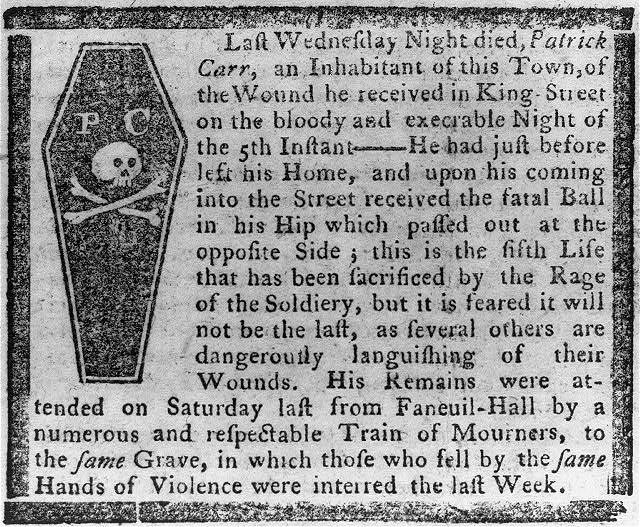
He arrived on King Street unarmed. Moments later the British soldiers fired into the crowd. Carr was struck in the abdomen. The wound was not immediately fatal, but in the medicine of the eighteenth century it was a death sentence.
He lingered for nine agonizing days before dying on March 14, 1770—the last of the five victims of what would soon be known as the Boston Massacre.
Three days later he was buried on March 17, 1770, St. Patrick’s Day.
Moral Clarity in the Face of Death
What happened during those nine days is one of the least remembered episodes in the early history of American law.
Carr was attended by Dr. John Jeffries, a surgeon who would later testify at the trial of the soldiers. Carr knew he was dying. The political pressure surrounding the event was enormous. Patriot leaders were already portraying the shooting as an act of deliberate slaughter by British troops.
Carr could easily have reinforced that narrative.
Instead, he told the truth as he understood it.
Jeffries later testified that Carr explained he had frequently seen soldiers confront mobs in Ireland and had even witnessed them fire upon crowds there. Yet Carr said he had never seen soldiers bear half so much provocation before firing as the British soldiers had endured on King Street that night.
Carr even forgave the man who shot him, believing the soldier had fired out of fear rather than malice.
His words became crucial testimony at the trial.
Because Carr knew he was dying, the court allowed Jeffries to recount his statement under what became known as the dying declaration exception to the hearsay rule—a principle rooted in the ancient legal maxim nemo moriturus praesumitur mentiri—a man who knows he is dying is presumed not to lie.
Carr’s reference to Ireland is not a throwaway line. It is the voice of an immigrant from a country where soldiers were often called out against crowds and where the coercive power of the state was not theoretical but lived reality. Carr was not speaking as a Boston bystander guessing at what “provocation” looked like. He was speaking as a man whose life experience included the hard edge of British rule in Ireland—and who still chose honesty over usefulness as he faced death.
Patrick Carr’s final words helped shape one of the earliest precedents of American jurisprudence.
The Defense of the Soldiers
The British soldiers were defended by Boston attorney John Adams.
Adams’ decision to represent the soldiers has long been celebrated as a courageous defense of the rule of law. Adams himself later wrote that condemning the soldiers unjustly would have stained the country as deeply as the witch trials.
And there is truth in that.
But the full story is more complicated.
Adams relied heavily on Patrick Carr’s dying declaration. Carr’s statement did more than simply support the defense—it gave Adams a powerful narrative tool. Carr had told Dr. Jeffries that he had witnessed soldiers confronting mobs in Ireland many times before and had even seen them fire on crowds there.
Adams was thus able to present Carr not merely as a victim, but as a man with unusual experience judging precisely the kind of confrontation the jury was being asked to evaluate.
In effect, Carr’s testimony allowed Adams to cast him as an informed observer of mob–soldier clashes. If a man who had seen such confrontations in Ireland believed the soldiers on King Street had shown remarkable restraint before firing, that judgment carried weight.
Carr’s dying words became one of the central pillars of the defense.
At the same time, Adams pursued another strategy in his closing argument. He sought to distance the victims from the respectable citizens of Boston.
In language that reflected the prejudices of the time, Adams described the crowd as
“a motley rabble of saucy boys, negroes and mulattoes, Irish teagues and outlandish jack tars.”
The word “teague” was a common insult directed at Irish Catholics.
He also referred specifically to
“an Attucks from Framingham, and a Carr from Ireland.”
Adams’ strategy was unmistakable. By emphasizing the backgrounds of the victims, he suggested to the jury that the soldiers had not fired upon the respectable citizens of Boston but upon a volatile crowd led by outsiders.
The strategy worked.
Six of the eight soldiers were acquitted. Two were convicted only of manslaughter and punished by branding on the thumb.
Why Patrick Carr Should Be Remembered
The Boston Massacre helped ignite the American Revolution. It became a symbol of British oppression repeated in speeches, pamphlets, and engravings across the colonies.
Patrick Carr was one of the five men whose deaths made that moment possible.
Yet his role extends beyond being a victim. His dying words became one of the most important pieces of testimony in the trial that followed and helped shape the principle of the dying declaration that remains part of American law today.
Carr was an Irish immigrant who came to Boston seeking honest work.
He was unarmed when he was shot.
He faced death with honesty and forgiveness when bitterness would have been understandable.
And in a final irony, the man whose testimony helped secure justice in the courtroom was dismissed in that same courtroom as “a Carr from Ireland.”
The Boston Massacre was a defining moment in the birth of the United States.
Patrick Carr was an integral part of that moment.
Yet history has largely forgotten him.
It should not. As we celebrate America 250 it is time to remember him.