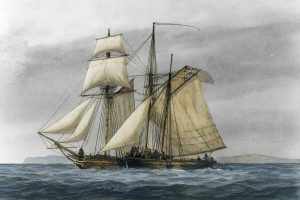
Long before the Irish were welcomed or celebrated in American life, they were already fighting for the country’s liberty. In the spring of 1775, in the small frontier settlement of Machias on the Maine coast, the son of Irish Catholic immigrants from County Cork led a band of lumbermen and fishermen against a British warship. His name was Jeremiah O’Brien, and the bold action he commanded would produce the first naval victory of the American Revolution.
Jeremiah O’Brien was born in 1744 in Kittery, in the district of Massachusetts that would later form the state of Maine, the eldest of six sons of Morris and Mary O’Brien—Irish Catholic immigrants from County Cork. In 1765, the family moved to Machias, a frontier settlement on the Maine coast. There the O’Briens established a sawmill along the Machias River. The enterprise prospered, and by the time he was an adult Jeremiah had become successful in the lumber trade, which also included operating coastal sloops that shipped timber to other New England ports.
O’Brien was also a committed patriot, devoted to the land that had afforded his family opportunities they could never have known in British-ruled Ireland. He served as a member of the Machias Committee of Safety, the town’s revolutionary governing body. When reports arrived of the battles of Lexington and Concord, O’Brien and others rallied the citizens of Machias to the cause of American liberty. As a visible sign of their commitment, they erected a Liberty Pole—a tall pine tree stripped of branches except at the top—and before it pledged to resist British oppression even if it required the sacrifice of their property and blood in defense of the town.
That vow was soon put to the test.
On June 7, 1775, the British armed schooner Margaretta arrived escorting two merchant sloops, the Unity and the Polly. The vessels carried provisions but were also intended to be loaded with lumber for British forces. The townspeople of Machias correctly deduced that the lumber would likely be used to build British fortifications in Boston. The merchant captain informed the town that supplies badly needed by the settlement would only be unloaded if the lumber was provided.
In the tense standoff that followed, the commander of the Margaretta—a British midshipman named James Moore who had been placed in temporary command—demanded that the Liberty Pole be taken down. John O’Brien, Jeremiah’s younger brother, reportedly replied, “Must come down? Those words are very easily spoken. You will find, I apprehend, that it is easier to make than it will be to enforce a demand of this kind.” Moore responded that his orders were “peremptory and must be obeyed,” warning that if the pole was not removed it would be his duty to fire upon the town.
Such a threat pushed even the town’s most cautious citizens toward rebellion. Soon afterward the merchant captain Jones and the Margaretta’s officers barely escaped an attempt to capture them while ashore attending church services. They fled back to the schooner and slipped away downriver, firing several warning shots in the process. After anchoring below the town, Moore sent word back to Machias that if harm came to the merchant captain or his vessels, the Margaretta would return to burn the village.
On June 11 Jeremiah O’Brien and his brother Daniel seized one of the provision ships, the Unity. Armed with muskets, fowling pieces, a small cannon, pitchforks, axes, and a party of thirty-five volunteers—five of them his brothers—O’Brien set out aboard the Unity to pursue the Margaretta. Seeing the improvised warship approaching through his spyglass, Moore attempted to make a run for the open ocean.
The Unity caught up with the Margaretta on June 12, 1775. When the vessels came within hailing distance, Moore demanded that O’Brien keep off and threatened to fire. O’Brien replied, “In America’s name, I demand you surrender!” Despite the superior firepower of the British schooner, O’Brien maneuvered alongside and led a boarding party onto the enemy vessel.
Recognizing that Jeremiah O’Brien was the driving force behind the attack, Moore ordered his men to fire at the audacious captain. O’Brien remained unscathed, but Moore himself was struck down by a shot from a marksman who had witnessed the attempt on O’Brien’s life.
O’Brien personally hauled down the British ensign. It was the first naval victory of the American Revolution.
The captured vessel was refitted as an armed cruiser. O’Brien rechristened her the Machias Liberty, and she became one of the first American armed cruisers of the Revolution.
British authorities soon took notice. The Royal Navy dispatched HMS Diligent and HMS Tapnaquish, reportedly with orders to bring the “obstreperous Irish Yankee” to trial. Instead, Jeremiah O’Brien and the Machias Liberty captured them both.
O’Brien continued to serve throughout the war as both a naval commander and a privateer. Over the course of the conflict he commanded at least six vessels, including the Resolution, Cyrus, Tiger, Saint Vincent, Little Vincent, and Hannibal. Operating in the waters of New England and Nova Scotia, his crews captured numerous British supply ships, disrupting British operations in the North Atlantic.
In 1780, while commanding the Hannibal, O’Brien himself was captured. He was imprisoned first aboard the notorious Jersey prison ship in New York Harbor and later transferred to Mill Prison in Plymouth, England.
After nine months in captivity he orchestrated a daring escape. O’Brien persuaded the prison’s washwoman to smuggle in civilian clothing in exchange for his last guinea. For weeks he deliberately allowed his appearance to deteriorate so the guards would not easily remember his earlier appearance. Then, during the evening guard change, he cleaned up, changed into the smuggled clothes, and calmly walked out of the prison. According to accounts of the escape, he even stopped at a local tavern before making his way to the coast, crossing the Channel to France, and eventually returning to America by the end of 1781.
After the war O’Brien was appointed customs collector in Machias, a position he held until his death in 1818. He is buried in the O’Brien family plot in Machias, Maine.
Five U.S. Navy ships have carried his name. The SS Jeremiah O’Brien, a World War II Liberty Ship preserved in San Francisco, remains one of the last operational vessels of its kind.
As the United States approaches its 250th anniversary, the story of Captain Jeremiah O’Brien deserves renewed attention. He secured the first naval victory of the American Revolution, led successful privateering campaigns, and served his country long after the war ended. He did all this as the son of Irish Catholic immigrants in a province whose laws and political culture had long been marked by anti-Catholic prejudice. O’Brien’s name deserves to be better remembered—not out of sentiment but because he earned it.