Across the Revolutionary War, five Butler brothers—sons of an Irish immigrant gunsmith—served as officers in the Continental Army. They fought in some of the most important campaigns of the war and continued their service into the early years of the American republic. Their story reminds us that the struggle for American liberty was strengthened by immigrants who carried with them a deep tradition of resistance to tyranny.
From Ireland to the Pennsylvania Frontier
The Butler story begins with Thomas Butler Sr., a gunsmith believed to have descended from the historic Butler family of Ireland, an old Irish line rooted in the country for centuries. In 1748 he and his wife, Eleanor Parker, emigrated to the American colonies and eventually settled in Carlisle, Pennsylvania, a frontier town on the edge of the American backcountry.
There Butler established a gunsmith shop supplying rifles to settlers and frontiersmen. His greatest legacy, however, was the five sons he raised—Richard, William, Thomas, Percival, and Edward—all of whom would serve as officers in the American cause.
Together they became known in the Continental Army as a “the Fighting Butlers” whose service stretched across the war.
Service Across the War
During the American Revolution, Thomas Butler Sr. was appointed Chief Armorer of the Continental Army; his sons appeared repeatedly wherever the fighting was hardest.
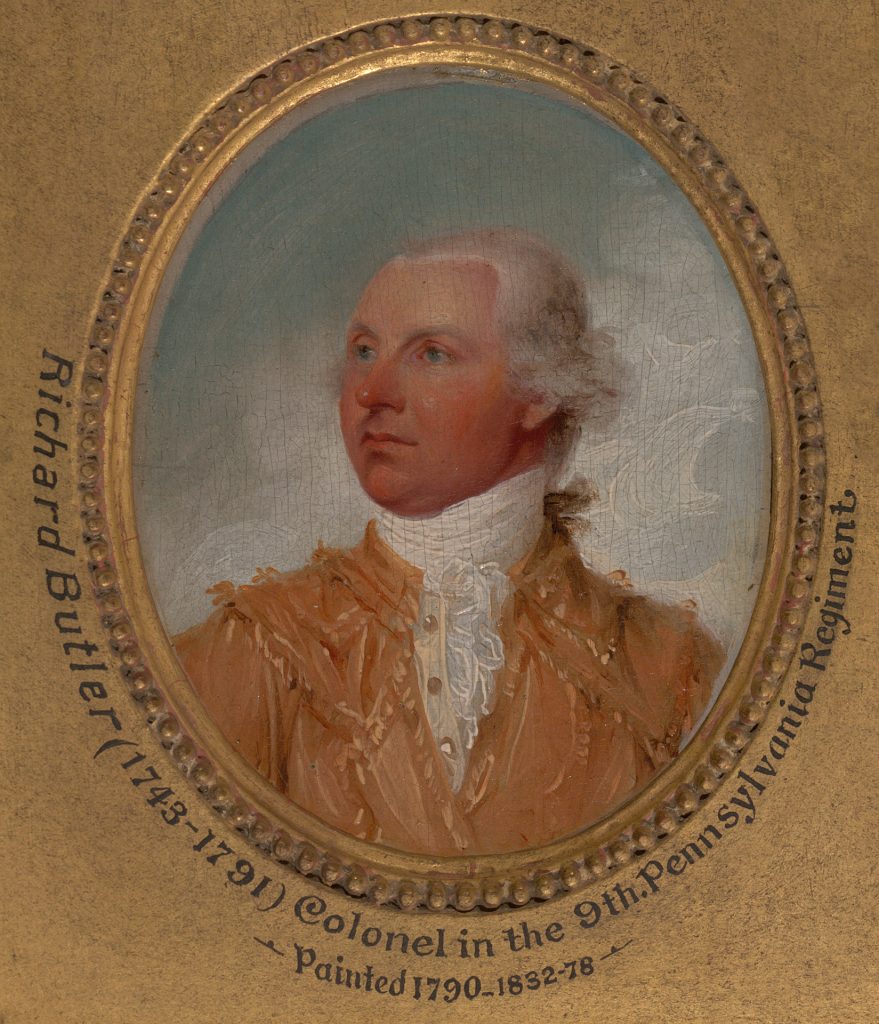
Richard Butler, born in Dublin, served with Daniel Morgan’s rifle corps during the Saratoga campaign and became one of the most respected officers in the Continental Army.
William Butler, also Irish-born, developed a reputation as an experienced frontier officer. He later took part in the Sullivan–Clinton Expedition, the campaign against the British-allied Iroquois in New York.
Thomas Butler distinguished himself at Brandywine and Monmouth, where he held a narrow defile under heavy attack, allowing American forces to withdraw in good order.
The younger brothers, Percival and Edward, joined the army as teenagers and endured the harsh winter at Valley Forge alongside the rest of Washington’s army.
Their service continued after the Revolution as the new nation began building its institutions. Percival Butler later became the first Adjutant General of Kentucky, while Edward Butler served as Adjutant General of the United States Army during its early years.
The Butlers at Stony Point
One of the most dramatic episodes in the Butler family’s service came during the American assault on Stony Point, NY on July 15, 1779.
The British fortification on the Hudson River was considered nearly impregnable and guarded a vital supply route. General Anthony Wayne planned a daring nighttime bayonet assault and selected Colonel Richard Butler to command the left column of the attacking force.
Advancing silently through marsh and water with unloaded muskets and fixed bayonets, Butler and his men closed with the British defenses under cover of darkness. Among the officers advancing with the column was Edward Butler, serving in his brother’s regiment.
The assault succeeded. The Americans stormed the fort and captured the garrison in one of the most daring operations of the war. The victory at Stony Point electrified the American cause and demonstrated the growing confidence and discipline of Washington’s army. The battle effectively ended British military in the North as they turned to the southern colonies
“The Butlers and Their Five Sons”
By the end of the war the Butler brothers had earned a reputation throughout the Continental Army.
Family tradition holds that following the victory at Yorktown, General George Washington raised a toast honoring: “The Butlers and their five sons.”
The Marquis de Lafayette, to whom Richard Butler served as one of aides presented Butler a fine sword in recognition of his service. Lafayette, is also to have remarked that when he needed something done well, he would “have a Butler do it.”
The Last Order
The most tragic chapter in the Butler story came not during the Revolution, but in the early years of the new republic.
In 1791, the young United States sent an army into the Northwest Territory (modern Ohio) during a growing frontier conflict between American forces and a Native confederacy in the region. The expedition was commanded by Major General Arthur St. Clair, with Major General Richard Butler serving as second in command.
On November 4, near the Wabash River, the American force was surprised and overwhelmed. The battle became known as St. Clair’s Defeat, the worst military disaster ever suffered by the United States Army in a battle with Native American forces.
Richard Butler fought throughout the battle despite being badly wounded. As the American lines collapsed, later accounts describe his brother Edward Butler finding him near the army’s camp. Edward was also attempting to save their brother Thomas, who had been severely wounded in the fighting.
Edward urged Richard to let him carry him from the field. Richard refused, realizing that he was mortally wounded and Edward could not carry them both. Richard gave Edward a direct order to save their brother instead.
Edward placed Thomas on a horse and escaped as the enemy overran the camp. Richard was seen still fighting with a pistol till the end.
A last Act of Irish Independence in the Butler Tradition
The Butler story also reveals something of the stubborn independence often associated with Irish soldiers.
Thomas Butler, continued serving in the United States Army long after the Revolution. In 1801 the Army ordered officers to cut off their traditional queue, the long braided ponytail worn by soldiers of the eighteenth century. Many officers complied. Thomas Butler refused believing that the general issuing the order was overstepping his authority.
He considered the order unnecessary and beneath the dignity of a veteran officer who had fought for the country’s independence. Rather than comply, Butler chose to face a court-martial.
The dispute became well known in early army circles. Butler accepted the punishment but never surrendered his position or his queue. Family tradition even holds that when he died he ordered a hole cut in his coffin so that his queue could hang through it; ensuring that even in death he would not obey the order.
An Irish Legacy for America 250
The story of the Fighting Butlers reminds us that the American Revolution was not fought by native-born colonists alone. Immigrants from Ireland stood in the ranks, commanded regiments, and helped secure the independence of the United States.
As America approaches its 250th anniversary, their story deserves to be remembered.
From a gunsmith’s shop on the Pennsylvania frontier to the battlefields of the Revolution, the Butler brothers carried with them the heritage of Ireland and helped forge a nation.
They were, in every sense, a gallant band of brothers.