
When Americans think of the naval heroes of the American Revolution, the name usually comes to mind is John Paul Jones. Yet there was another officer—an Irish immigrant from County Wexford—whose service was longer, whose seniority was higher, and whose influence extended beyond the war itself to the very creation of the United States Navy.
His name was Commodore John Barry.
As we mark Irish American Heritage Month and approach the 250th anniversary of American independence, Barry deserves to be better remembered. He was not a colorful footnote in the founding of the Republic. He was one of the men who fought for its independence and then helped build the navy that would defend it.
John Barry was born on March 25, 1745, in Ballysampson in the parish of Tacumshane, County Wexford, the son of a Catholic small-farming family. Like many Irish tenants under British rule, the Barrys faced hardship. Eventually evicted from their land, the family moved toward the coast near Rosslare. For the young Barry, the sea offered opportunity where the land did not.
His uncle, Nicholas Barry, was a shipmaster sailing out of Rosslare Harbour, and John went to sea as a cabin boy while still in his early teens. By about age fifteen he had left Ireland entirely, sailing first to the Caribbean and eventually to Philadelphia, one of the busiest ports in British America.
Philadelphia rewarded ability. By the early 1760s Barry had become a merchant captain in the city’s Atlantic trade. This was no small accomplishment for a teenage immigrant from rural Wexford. Long before the Revolution began, Barry had already earned respect as one of the finest captains operating out of Philadelphia.
One story from his merchant years illustrates his skill. While commanding the vessel Black Prince, Barry sailed 237 miles in a single twenty-four-hour period on a return voyage from England—said by contemporaries to be the fastest day’s sailing then recorded. Whether remembered for speed, judgment, or nerve, Barry had already established himself as a master mariner before he ever wore an American uniform.
When resistance to British rule hardened into revolution, Barry cast his lot with his adopted country and gave up what many considered the most profitable merchant career in America. On December 7, 1775, the Continental Congress converted the merchant vessel Lexington into a warship and gave Barry command. In March 1776, he received his commission as a captain in the Continental Navy. When officer seniority was later established, Barry ranked seventh among Continental naval captains, placing him among the most senior officers of the new service.
Barry’s importance during the Revolution lies not in one spectacular moment alone, but in the steady record of his service. He commanded several Continental warships—including Lexington, Effingham, Raleigh, and Alliance—and remained in continuous naval service at a time when the Continental Navy struggled simply to keep ships at sea.
His first notable action came early in the war. In June 1776, while involved in operations around the brig Nancy, Barry oversaw the salvage of desperately needed gunpowder while British forces closed in. With capture inevitable, the grounded ship was destroyed using a delayed fuse in what became known as the Battle of Turtle Gut Inlet off the New Jersey coast. The explosion killed British boarding parties and denied them the cargo. It was a small action, but an early and important success for the American naval cause.
Soon afterward, while commanding Lexington, Barry captured the British tender Edward, often cited as the first British vessel taken under the authority of the Continental Navy.
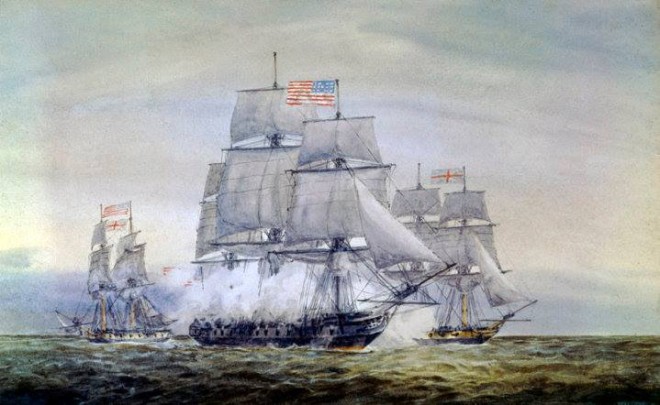
Barry later commanded the frigate Alliance, one of the most effective ships in American service. On May 29, 1781, Alliance fought a fierce engagement with the British sloops Atalanta and Trepassey. Barry was seriously wounded during the battle but refused to leave the deck.
Under his command, the American ship forced both British vessels to surrender and took them as prizes.
In 1782, Alliance under Barry captured multiple British merchant prizes—including Britannia, Anna, Commerce, and Kingston—demonstrating that American warships could still strike at British commerce even in the closing phase of the war.
Finally, on March 10, 1783, south of Cape Canaveral, Alliance fought what is widely regarded as the last naval engagement of the American Revolution, successfully beating off British opponents before word of peace arrived.
But Barry’s importance did not end when the war did. In many ways, his most lasting contribution came afterward.
When the United States established a permanent navy in the 1790s, Barry was appointed the senior captain of the new service, holding Commission No. 1 in the United States Navy. In practice he served as the navy’s senior officer—effectively commodore—and was given command of one of the original heavy frigates authorized by Congress, the USS United States.
Barry helped supervise the construction and fitting-out of the new warships and worked to establish standards of discipline, training, and professionalism. He authored an early naval signal book, helping standardize communications between ships, and mentored younger officers who would later distinguish themselves with the American naval forces during the War of 1812.
Through these efforts Barry helped bridge the gap between the wartime Continental Navy and the permanent United States Navy that followed.
John Paul Jones’s naval career was defined by a few bold and dramatic actions and a memorable phrase; Barry’s was longer, steadier, and more productive. He served continuously through the Revolution, held senior rank among naval officers, fought numerous engagements, and then helped build the navy that emerged after independence.
Yet despite this record, Barry’s name is far less familiar in the national memory. Dramatic single battles tend to capture public imagination, while the patient work of building institutions is often overlooked. But the truth is that the American Navy that defended the young republic in the decades after independence owed much to the discipline, leadership, and example set by the Irish captain from Wexford.
John Barry remained the senior officer of the United States Navy until his death in Philadelphia on September 13, 1803.
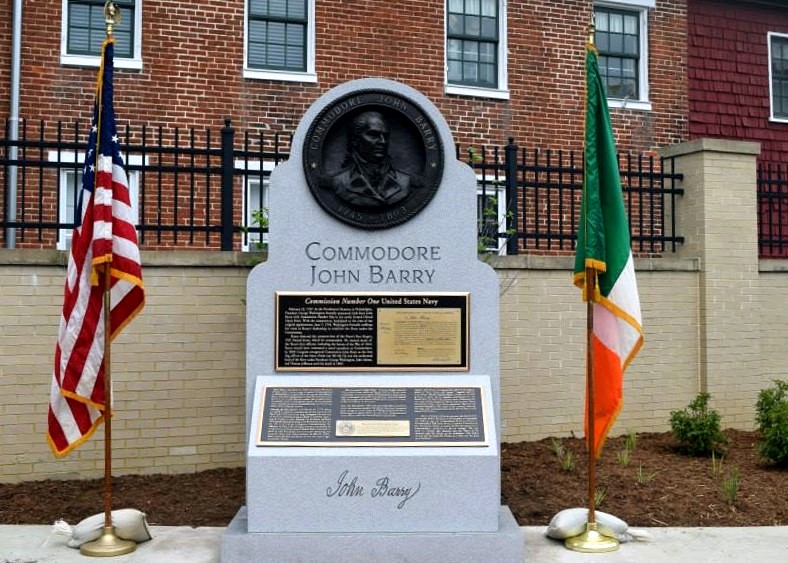
For Irish Americans, his story carries special meaning. Born into the hardships of colonial Ireland, the son of a Catholic tenant family, Barry crossed the Atlantic, mastered his profession, and placed his skill and courage at the service of American independence.
He did not merely participate in the American story.
He helped shape it.
As we approach America’s 250th anniversary, remembering John Barry reminds us of something often forgotten in the telling of our nation’s beginnings:
From the earliest days of the Republic—on land and at sea—Irish hands were there.