Few modern New York police officers better embodied the Irish American tradition of faith, service, and moral courage than NYPD Detective Steven McDonald. Shot in the line of duty in Central Park in 1986 and left paralyzed for life, McDonald became known not simply for surviving the attack but for the extraordinary act that followed—his public forgiveness of the teenager who shot him.
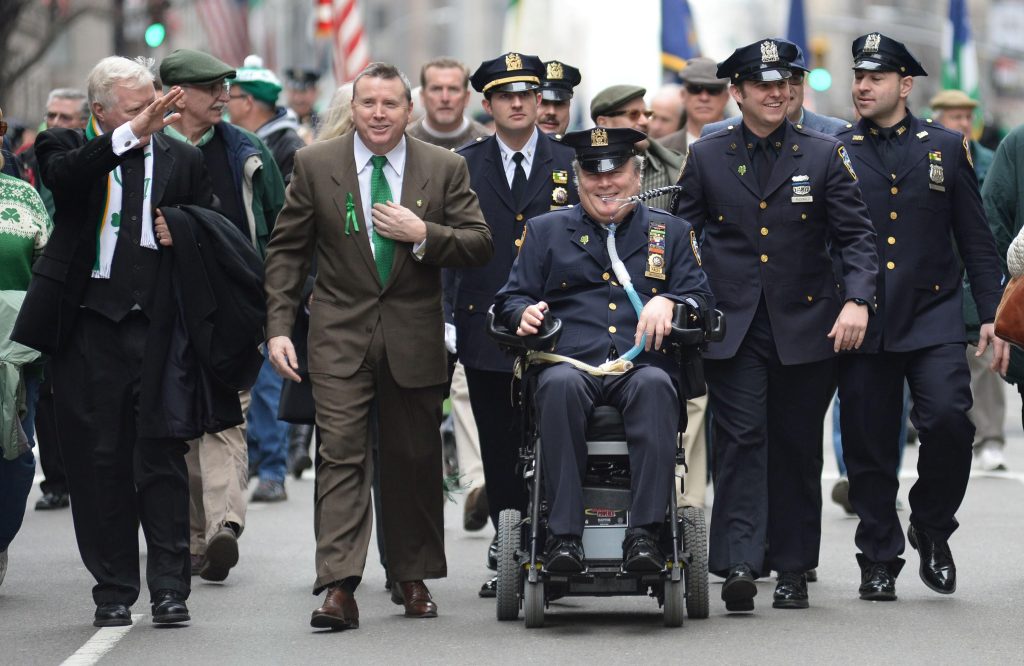
For the next three decades, McDonald carried that message of forgiveness far beyond New York. Speaking in parishes, schools, and community halls, and even traveling to Northern Ireland during the difficult years of its peace process, he became one of the most respected voices for reconciliation in public life.
An Irish American Tradition of Service
Steven McDonald was born on March 1, 1957, in Queens Village, New York, and grew up in Rockville Centre, Long Island, in a devout Irish Catholic family. He was one of eight children of David and Anita McDonald, a household where faith and service shaped daily life.
His father, Sergeant David McDonald, served in the New York City Police Department and was a founding member of the NYPD Emerald Society. Like many Irish American families in New York, the McDonalds viewed service in uniform not simply as a career but as a calling.
Steven followed naturally into that tradition, becoming a third-generation member of the NYPD. His brother Thomas also served in law enforcement, and the family’s legacy continues today through his son Conor McDonald, now an NYPD Captain.
The McDonalds embodied what police officers often call the “long blue line”—a multi-generational commitment to protecting the city that Irish Americans helped build.
The Shooting in Central Park
On July 12, 1986, Patrolman McDonald and his partner were on foot patrol in Central Park near Fifth Avenue and 107th Street. They had been investigating a pattern of bicycle thefts when they stopped three teenagers they suspected were preparing to steal bicycles.
During the encounter, fifteen-year-old Shavod “Buddha” Jones suddenly produced a concealed .22-caliber handgun.
He fired three times.
The bullets struck McDonald in the head, neck, and hand, leaving the young officer paralyzed and dependent on a ventilator. Doctors initially doubted he would survive.
McDonald defied those predictions and lived for more than thirty years after the shooting, remaining an active member of the NYPD. In recognition of his perseverance and service, he was promoted to Detective in 1995 and later to Detective First Grade in 2003.
The event that defined his life, however, came several months later.
The Baptism at Bellevue
Six months after the shooting, while still recovering at Bellevue Hospital, Steven and Patti Ann McDonald brought their newborn son Conor to the hospital chapel to be baptized.
Because McDonald could not speak publicly, he asked his wife to read a statement to reporters gathered outside.
The words stunned New York.
“I forgive him and hope he can find peace and purpose in his life.”
The statement referred to the teenage gunman who had shot him in Central Park.
At a time when violence and anger dominated the headlines, McDonald chose a different response. Reflecting on the decision later, he explained the choice he faced:
“There were two ways to move forward—love and forgive the boy who shot me, or choose bitterness and hatred.”
From that day forward, forgiveness became the central message of his life. McDonald often expressed the lesson simply:
“Forgiveness is not an occasional act. It is a permanent attitude.”
As his son began life through the sacrament of baptism, McDonald publicly rejected the cycle of hatred that violence so often creates.
A Message Carried to Ireland
Out of his personal suffering, McDonald developed a mission that carried him far beyond New York.
Confined to a wheelchair, he traveled widely as a speaker and advocate for reconciliation, bringing his message of forgiveness to communities struggling with violence and division.
Among the places he returned to repeatedly was Northern Ireland, where the legacy of the Troubles still weighed heavily on daily life. In the years following the Good Friday Agreement, McDonald spoke in both Protestant and Catholic communities about forgiveness and the possibility of breaking cycles of violence.
Reflecting on those visits, he said with characteristic humility:
“I spent part of four summers up in the North, and people there helped me more in my situation than I’ve helped them.”
A Legacy for Irish America
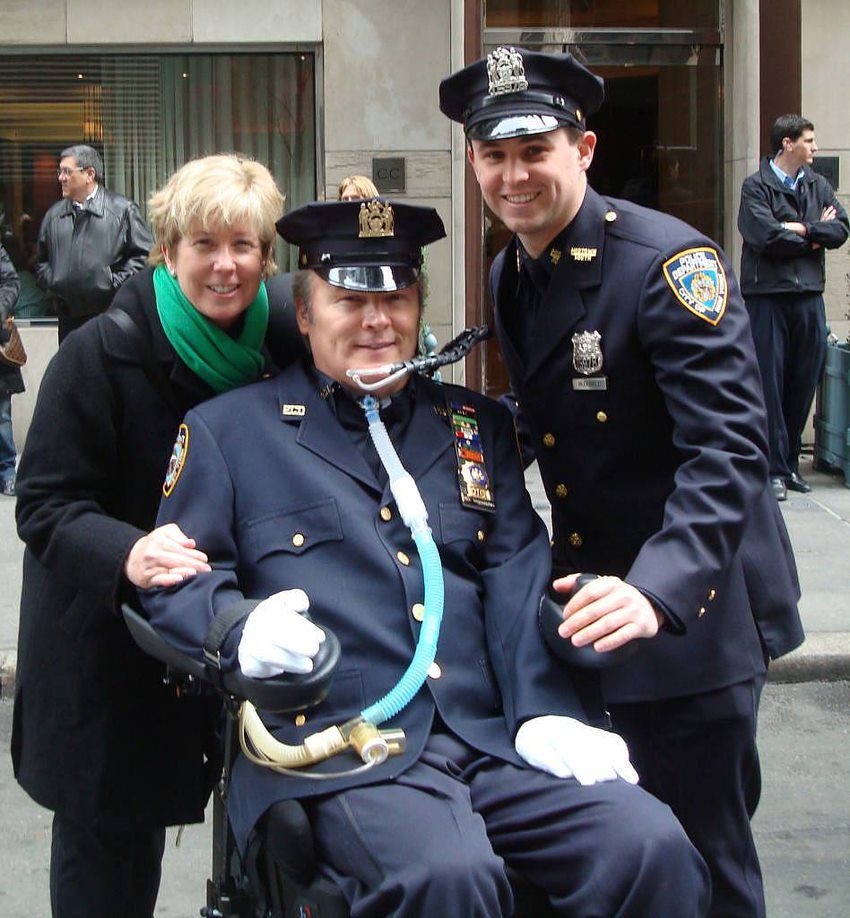
Over time, Steven McDonald became one of the most respected figures associated with the New York Police Department. He met Pope John Paul II, spoke with Nelson Mandela, and appeared regularly at police, civic, and parish gatherings across the country.
When he died on January 10, 2017, from complications related to his injuries, thousands gathered at St. Patrick’s Cathedral for his funeral.
Steven McDonald’s life reflects several of the strongest strands of the Irish American experience: faith rooted in Catholic tradition, service to community, and the belief that reconciliation is possible even after great suffering.
For Irish Americans marking Heritage Month, his life stands as a reminder that the traditions our community brought to this country—faith, service, and moral courage—remain as relevant today as they were to earlier generations who helped build the nation.