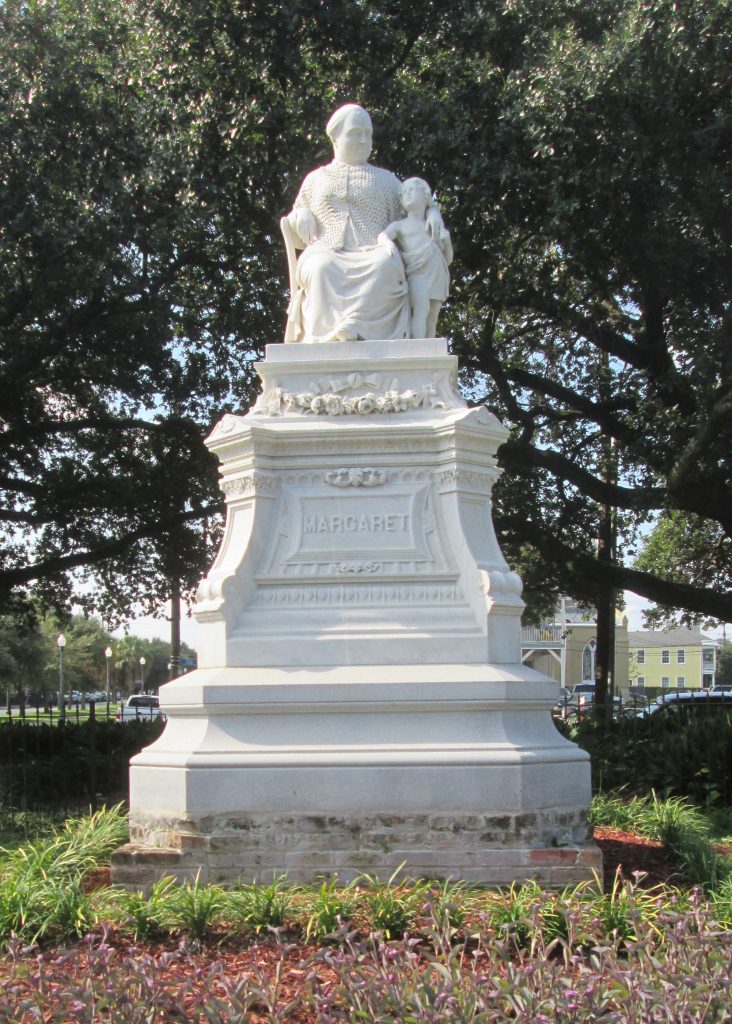
In Margaret Place, a small park in New Orleans’ Lower Garden District where Clio and Prytania Streets meet, a Carrara marble statue of a woman sits in a chair with her arm around a child. She is plain, a bit plump, her face square-chinned, but in her eyes a look of love and compassion. Sculpted by Alexander Doyle and unveiled in 1884, it is the first public monument in the United States erected to honor a female philanthropist. The pedestal bears one word: Margaret, because to the people of New Orleans, nothing more needed to be said.
Margaret Gaffney was born in 1813 near Carrigallen, County Leitrim, Ireland. Her family emigrated around 1818 and settled in Baltimore, where both parents died of yellow fever around 1822, leaving her orphaned at nine. She was taken in by a family as domestic help and never received a formal education.
In 1835, she married Irish-born Charles Haughery, and the couple moved to New Orleans. Tragedy followed: Charles died, and their infant child soon after, leaving her a grieving, penniless widow in an unfamiliar city.
The Sisters of Charity helped her find laundry work at the St. Charles Hotel. She began visiting nearby orphan asylums, donating much of her wages and volunteering her time. Seeing the children’s need, she bought two cows and a cart, selling milk door to door before work and donating the profits. Her herd grew to some 40 cows, and on her morning rounds, she collected day-old food from hotels and bakeries to bring back to the children.
Working with the Sisters of Charity, she helped fund and build St. Theresa’s Orphan Asylum around 1840, effectively serving as a lay co-founder alongside Sister Regis. When yellow fever epidemics struck in the 1850s, she went door to door nursing the sick and promising dying mothers she would care for their children. The St. Vincent de Paul Infant Asylum followed in 1862. Over her lifetime, she helped establish or sustain roughly a dozen orphanages in New Orleans, serving all regardless of creed or race.
When a baker she had loaned money to went bankrupt, she took over his bakery to recoup her loss and turned it into one of the city’s great enterprises. She created the first steam-powered bakery in the American South, exporting beyond New Orleans, and is credited with introducing packaged crackers to the local market. She supplied every orphan asylum in the city with bread at prices so low it was effectively free, all while continuing to deliver it by handcart herself.
When Union General Benjamin Butler occupied New Orleans and imposed martial law, she crossed military lines to continue feeding the hungry. Summoned before Butler and warned she would be shot, she replied she would write to President Lincoln and ask if it was his policy to starve the poor. Butler stormed: “You are not to go through the picket lines without my permission, is that clear?” “Quite clear,” she answered—and Butler, noting her resolute expression, added: “You have my permission.”
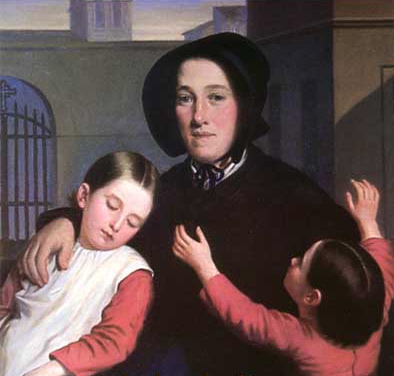
By the end of the Civil War, she was a civic institution. She sat at the open door of the orphanage in a calico gown and shawl, with a word for everyone who passed—rich or poor, of any race, of any faith. Despite managing a considerable enterprise, she never owned more than two dresses and wore the same Quaker bonnet that had become her trademark.
Margaret Gaffney Haughery died on February 9, 1882. The city’s newspapers were edged in black. Her funeral procession was the largest New Orleans had ever seen, the mayor leading it and the governor serving as pallbearer.
When her will was read, she had left her entire estate, a considerable sum, to the orphanages and homes she had spent her life building. The will was signed with a cross—she never learned to read or write.
The citizens of New Orleans raised funds for a monument with one condition: no large donations would be accepted, so that no single person could claim credit. Nickels and dimes came in from across the city. Two years after her death, Alexander Doyle’s Carrara marble statue was unveiled in Margaret Place by children from every orphanage in the city. It still stands there today.
The pedestal still bears only one word: MARGARET.
A name that reflects the best of Irish America and sets a standard to be matched.